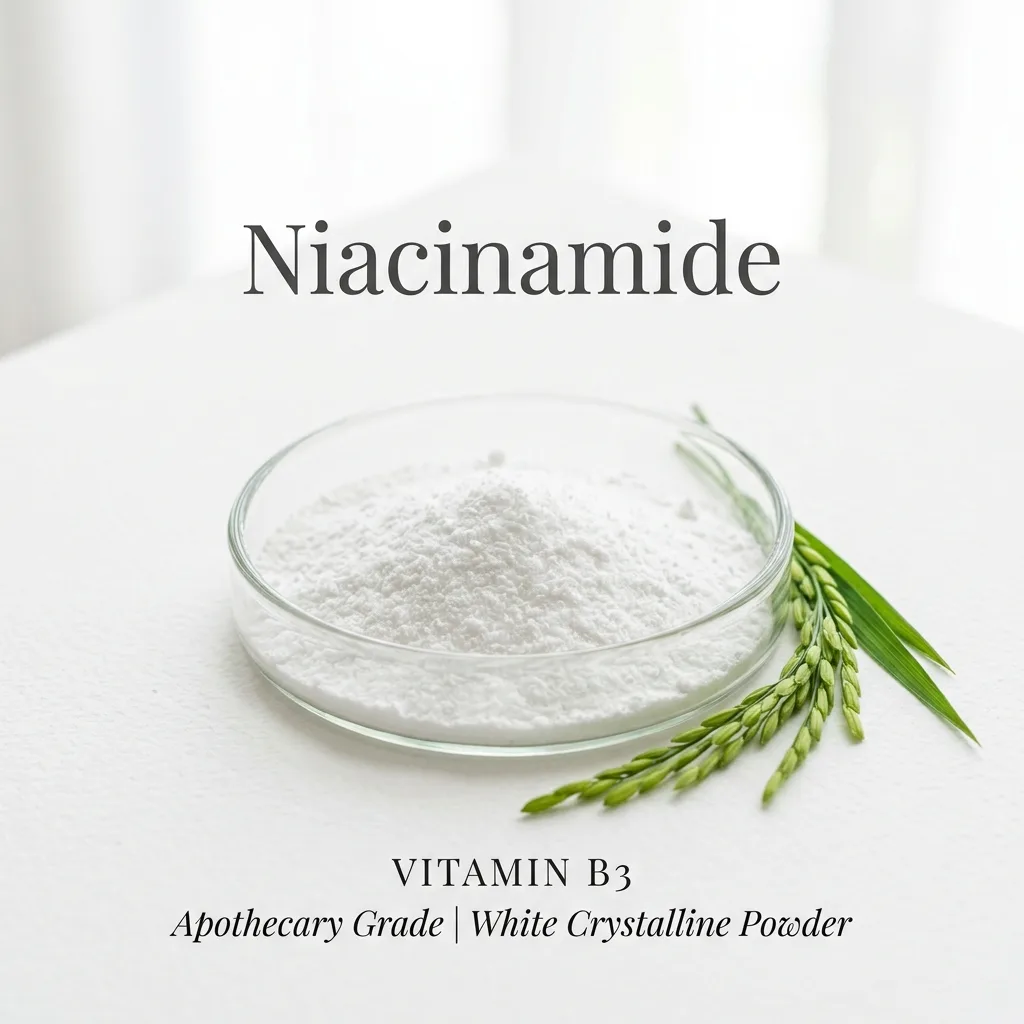
What Is Niacinamide?
Niacinamide, also known as nicotinamide, is the amide form of Vitamin B3 (niacin). It is a water-soluble vitamin and essential micronutrient that plays a central role in cellular energy metabolism. At the cellular level, niacinamide is a precursor to two critical coenzymes: NAD+ (nicotinamide adenine dinucleotide) and NADP+ (nicotinamide adenine dinucleotide phosphate). These molecules are involved in hundreds of biochemical reactions throughout the body, including cellular respiration, DNA repair and antioxidant defence.
In cosmetic dermatology, niacinamide has emerged over the past two decades as one of the most comprehensively researched topical actives. Its inclusion in the Max Vibe formula is supported by a robust body of evidence spanning peer-reviewed journals including the International Journal of Dermatology, Dermatologic Therapy and the British Journal of Dermatology.
Mechanism of Action: How Niacinamide Works on Skin
Skin Barrier Strengthening
One of the most extensively documented effects of topical niacinamide is its ability to enhance the skin's barrier function. The skin barrier — primarily composed of ceramides, free fatty acids and cholesterol in the stratum corneum — prevents transepidermal water loss (TEWL) and protects against environmental damage. Research published in the Journal of Investigative Dermatology (Tanno et al., 2000) demonstrated that niacinamide significantly increased the synthesis of ceramides and other stratum corneum lipids at concentrations of 0.1–1 mM in cultured keratinocytes.
Enhanced barrier function in intimate skin has direct practical benefits: it reduces irritation from friction, maintains appropriate hydration levels and creates a more resilient tissue environment that responds better to topical active delivery.
Skin comfort Support
Perhaps most relevant to Max Vibe's intimate health application is niacinamide's relationship with vascular function. As a NAD+ precursor, niacinamide supports the energy metabolism of endothelial cells — the cells that line blood vessels. Healthy endothelial function is essential for appropriate warmth, vascular tone and microvascular perfusion of peripheral tissues.
Research from the American Journal of Clinical Nutrition (2004) and subsequent topical studies have explored how niacinamide may support nitric oxide signalling pathways. Nitric oxide (NO) is the primary vasodilator in the body — it relaxes smooth muscle in blood vessel walls, allowing vessels to widen and skin warmth to increase. While this mechanism has been studied most extensively in the context of cardiovascular health, the principle applies equally to peripheral skin comfort, including intimate tissue.
Anti-Inflammatory Properties
Niacinamide has documented anti-inflammatory activity in skin tissue. Studies have shown it can reduce production of pro-inflammatory cytokines, which are signalling molecules involved in inflammatory responses. In the context of intimate skin — which can be susceptible to minor irritation from friction or environmental factors — this anti-inflammatory effect contributes to a calmer, more comfortable tissue environment.
Antioxidant Activity
Through its role as a NAD+ precursor, niacinamide indirectly supports the antioxidant defences of skin cells. NAD+ is required for the activity of sirtuins — proteins that regulate cellular stress responses and help protect cells from oxidative damage. This antioxidant support complements the direct antioxidant action of Tocopherol (Vitamin E), the other antioxidant ingredient in Max Vibe.
Research Evidence for Topical Niacinamide
The evidence base for topical niacinamide is one of the strongest in cosmetic dermatology. Key published research includes:
- Bissett et al. (2004) — Published in the International Journal of Cosmetic Science, demonstrated that 5% topical niacinamide significantly improved skin appearance and reduced visible changes associated with ageing over 12 weeks of use, with good tolerability.
- Draelos et al. (2005) — Randomised controlled study in Cutis showing niacinamide at 4% significantly improved skin smoothness and hydration versus placebo.
- Tanno et al. (2000) — Study in keratinocyte cultures documenting niacinamide-induced ceramide synthesis, forming the mechanistic basis for barrier-strengthening claims.
- Multiple studies in Dermatologic Therapy — Confirming anti-inflammatory mechanisms and tolerability of niacinamide across skin types and sensitivities.
While most research on topical niacinamide has been conducted in the context of facial or body skin, the underlying mechanisms — barrier support, skin comfort, anti-inflammatory activity — are relevant to intimate skin application given the comparable tissue physiology.
Why Topical vs Oral Niacinamide?
Niacinamide is available both as an oral supplement and as a topical ingredient. For the purposes of local intimate skin application, topical delivery offers several advantages:
- Localised concentration: Topical application delivers niacinamide directly to the target skin area without systemic distribution or hepatic first-pass metabolism.
- No flushing risk: Unlike oral niacin (nicotinic acid), topical niacinamide does not cause the characteristic vasodilatory flushing response, making it suitable for sensitive skin applications.
- Complementary delivery: In the gel matrix, niacinamide is delivered alongside other synergistic actives (ginger, guarana, hyaluronic acid), creating multi-mechanism support from a single application.
Niacinamide in the Max Vibe Formula
In Max Vibe, niacinamide appears second in the INCI list (after glycerin), indicating it is one of the primary active ingredients by concentration. Its inclusion is designed to:
- Support healthy microvascular function in intimate tissue through endothelial NAD+ support
- Strengthen the skin barrier to reduce irritation and improve the delivery environment for other actives
- Provide anti-inflammatory protection during and after application
- Contribute to the overall tissue-conditioning effect of the formula alongside sodium hyaluronate and tocopherol
The combination of niacinamide with ginger extract creates a complementary dual-mechanism approach to skin comfort support: niacinamide via endothelial NAD+ metabolism and ginger via TRPV1-mediated warmth. This synergistic action may provide more comprehensive local circulatory support than either ingredient alone.
Safety Profile of Niacinamide in Intimate Products
Niacinamide has an excellent safety profile. It is classified as non-toxic, non-sensitising and non-comedogenic. The EU Cosmetics Regulation (EC) No 1223/2009 places no restrictions or concentration limits on niacinamide in cosmetic products, confirming its established safety at concentrations used in commercial formulations. The ingredient does not appear on the EU's list of restricted or prohibited cosmetic substances.
For intimate skin applications, niacinamide is particularly appropriate because it is:
- Non-irritating even at effective concentrations
- Compatible with sensitive mucous-membrane-adjacent skin
- Stable across a wide pH range
- Well-established in topical cosmetic formulations worldwide